
Best Curtains and Blinds for UAE Villas – Heat Resistant & Stylish
Most villa owners in Dubai replace their window treatments within two years of moving in. Not because they chose badly, but because they chose for aesthetics alone and underestimated what a UAE summer does to fabric, colour, and track hardware. A west-facing window in Arabian Ranches or Palm Jumeirah can reach surface temperatures above 60 degrees Celsius in July. That is not a styling problem. It is an engineering one.
Why UAE Villas Demand a Different Approach to Window Treatments
A standard off-the-shelf curtain from a European retailer is designed for a climate where UV index rarely exceeds 6. The UAE summer routinely hits UV index 11 or higher, and that radiation does two things simultaneously. It bleaches colour out of underprepared fabrics within a season and drives interior temperatures up significantly in rooms with inadequate solar control.
Villas compound this challenge compared to apartments. You are typically dealing with full-height windows, often 2.8 to 3.5 metres, double-height living rooms in some Arabian Ranches or Damac Hills configurations, and a mix of orientations in the same property. The west-facing family room, the south-facing master bedroom, and the east-facing kitchen all need different solutions, and a single fabric specification will not serve all three well.
The good news is that the UAE market has matured. There is now a wide range of purpose-built fabrics, operating systems, and track hardware that genuinely performs under these conditions. The price gap between poor-quality imports and properly specified products is smaller than most people expect.
What Makes a Curtain or Blind Heat-Resistant in Practice?
Heat resistance in window treatments is not a single property. It breaks down into three distinct performance areas that are often confused or conflated in marketing material.
Solar Heat Gain Control
Solar heat gain control refers to how much radiant energy a fabric allows through into the room. A fabric’s solar transmittance is quantified by its openness factor: a blackout lining has 0% openness, a sheer voile might run 8-12%. For UAE villas, any room facing west or south should have an openness factor below 3% on the primary treatment layer to meaningfully reduce air-conditioning load. Roller blinds in a 1-3% openness fabric are particularly effective here because they sit closer to the glass than curtains and intercept radiation before it enters the room air.
UV Resistance
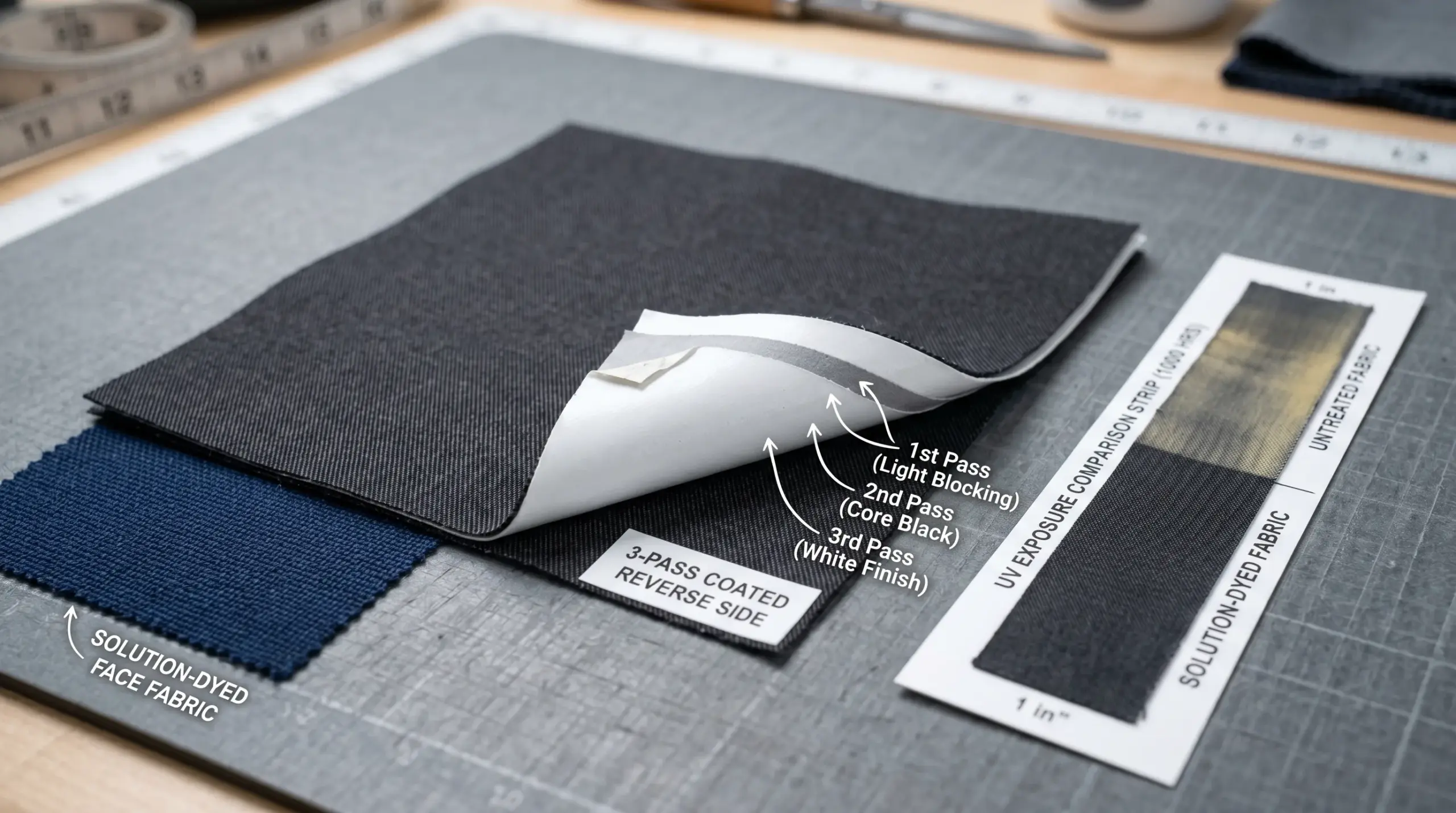
UV resistance governs how quickly the fabric itself degrades, fades, and loses tensile strength. Look for fabrics rated to at least 5 on the Blue Wool Scale. This is the standard used by most quality European and UAE-sourced solution-dyed fabrics. Solution-dyed acrylic and polyester fabrics have colour locked into the fibre at manufacture rather than applied as a surface dye, which dramatically extends their useful life. Linens and cotton-weave fabrics, however beautiful, will fade and weaken in direct UAE sun within 12-18 months without a UV-blocking lining.
Thermal Stability of Hardware
Thermal stability of hardware is the element most homeowners overlook entirely. Standard aluminium tracks and PVC-based roller blind tubes can warp or deform at sustained temperatures above 50 degrees Celsius, which a sealed bay window easily achieves in summer. Specify anodised aluminium or powder-coated steel tracks, and ask your supplier whether the roller mechanism uses a heat-stable clutch. The cheap plastic clutches fail within two UAE summers.
The Best Curtain Types for UAE Villas
S-Fold and Wave Curtains: The Premium Choice for Villa Living Rooms
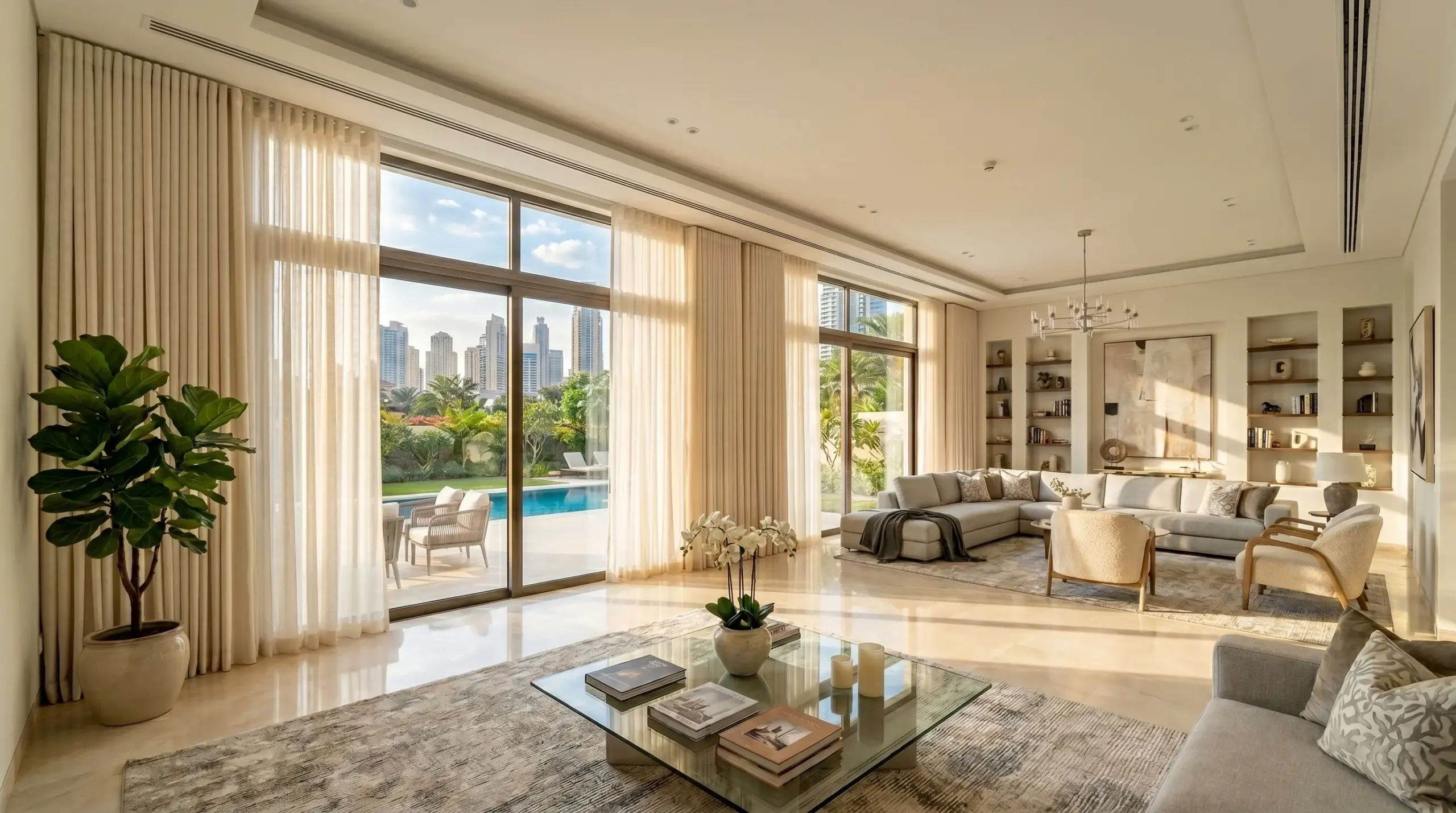
S-fold and wave curtains, where the fabric is pleated to hang in continuous, even curves, have become the dominant choice for high-end Dubai villa renovations. The reason is partly aesthetic, partly practical. The even fold distribution means the fabric stacks tightly when open, maximising light and view during the cooler morning hours, and falls in a uniform, controlled way when drawn.
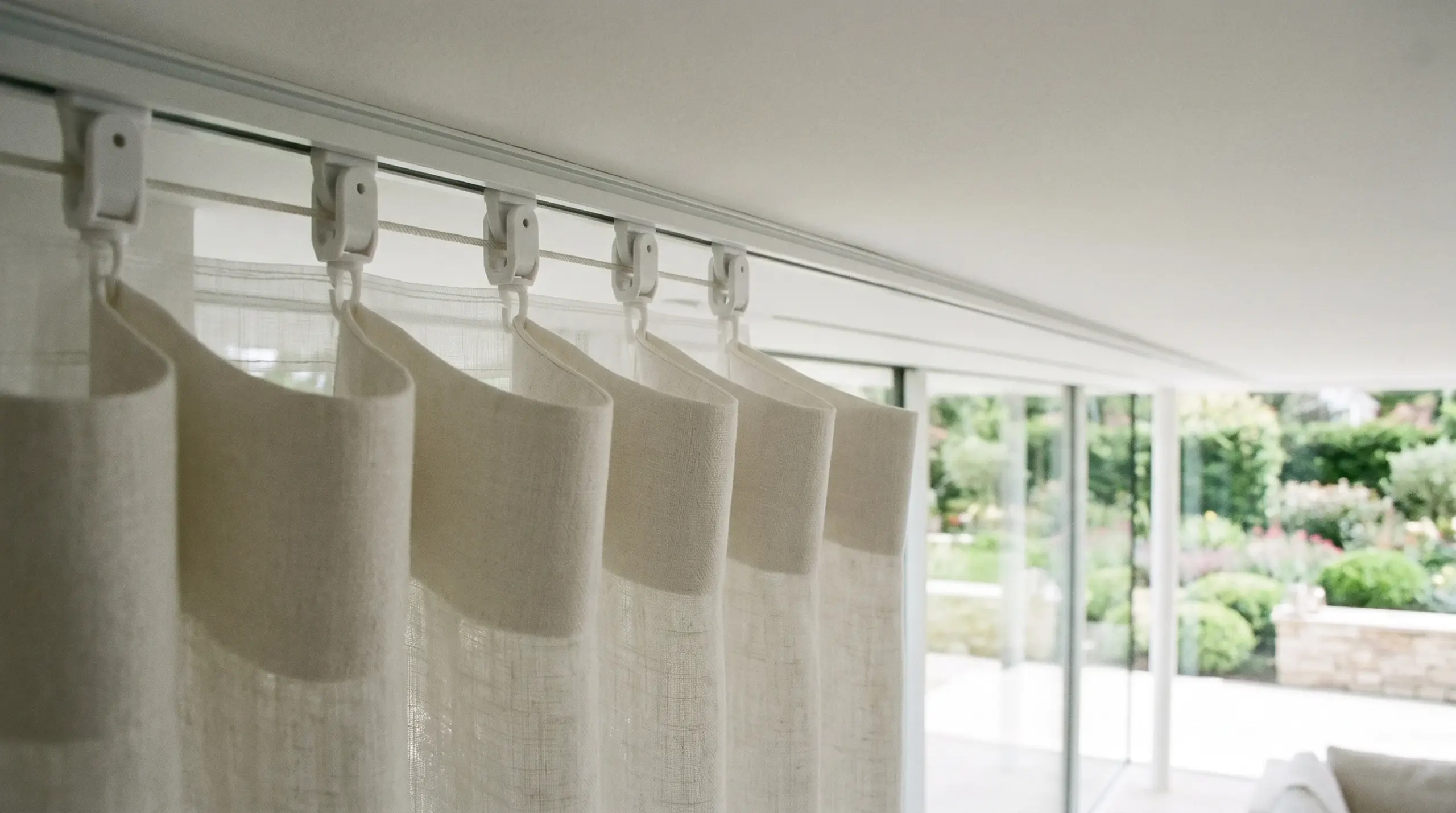
From a performance standpoint, they are well-suited to the double-lining systems that UAE conditions demand. A wave curtain can be specified with an interlined blackout layer stitched between the face fabric and the backing. This combination provides meaningful thermal buffering on south and west aspects, reduces condensation risk on the glass in winter months, and creates good acoustic separation in rooms near pool areas or courtyards.
Custom wave and S-fold curtains in Dubai typically cost AED 220-420 per linear metre installed, depending on fabric weight, lining specification, and track type. Floor-to-ceiling configurations in large villa living rooms with 3-metre drops are at the upper end of that range. Lead times from fabric sign-off are typically 3-5 weeks. Allow an additional week during Ramadan.
Blackout Curtains for UAE Bedrooms
Blackout performance in a UAE bedroom context serves two distinct purposes that are worth separating. The first is genuine light exclusion, critical in a region where the sun rises before 6 AM in summer and where a single-layer curtain is visually comfortable but lets enough light through to disrupt sleep. The second, less discussed, is reducing the radiant heat load into the room at night from a wall that has been absorbing solar energy all day.
A true blackout curtain uses a coated or laminated liner, typically a three-pass blackout coating, that achieves near-zero light transmission. These liners are effective but can feel heavy and institutional if not balanced by a well-chosen face fabric. In our experience fitting out bedrooms across JBR, Business Bay, and Palm Jumeirah, the most successful combinations pair a textured, heavier-weight linen-look polyester face fabric with a sewn-in blackout lining, which keeps the room looking considered rather than utilitarian.
Installed blackout curtains for UAE villa bedrooms typically run AED 180-320 per metre, depending on fabric and track. Eyelet-fixed systems are cheaper but perform less well in UAE conditions. The grommets allow light bleed at the edges and the fabric does not stack as cleanly. A ceiling-mounted track with a return to the wall is worth the additional AED 15-25 per metre for proper light exclusion.
Sheer Curtains: Privacy Without Sacrificing Light
Sheers are often treated as a secondary layer, added purely for aesthetics. But in a UAE villa context they do meaningful work during daylight hours. A quality sheer with a low-openness weave (3-5%) provides daytime privacy from the street or from neighbouring villas without significantly reducing natural light. This matters particularly in communities like The Springs, Mirdif, or Jumeirah Village Circle where villas sit close to one another.
The risk in the UAE market is that low-quality sheers, particularly those sold at bulk traders, are thin-woven and prone to yellowing within a year in UV-heavy rooms. Specify a sheer with a minimum 100g/m2 weight and a solution-dyed polyester composition. These hold their white or off-white colour reliably and are washable, relevant in a country where dust settles on interior fabric faster than in most markets.
Blinds vs Curtains for UAE Villas: Which Is Better?
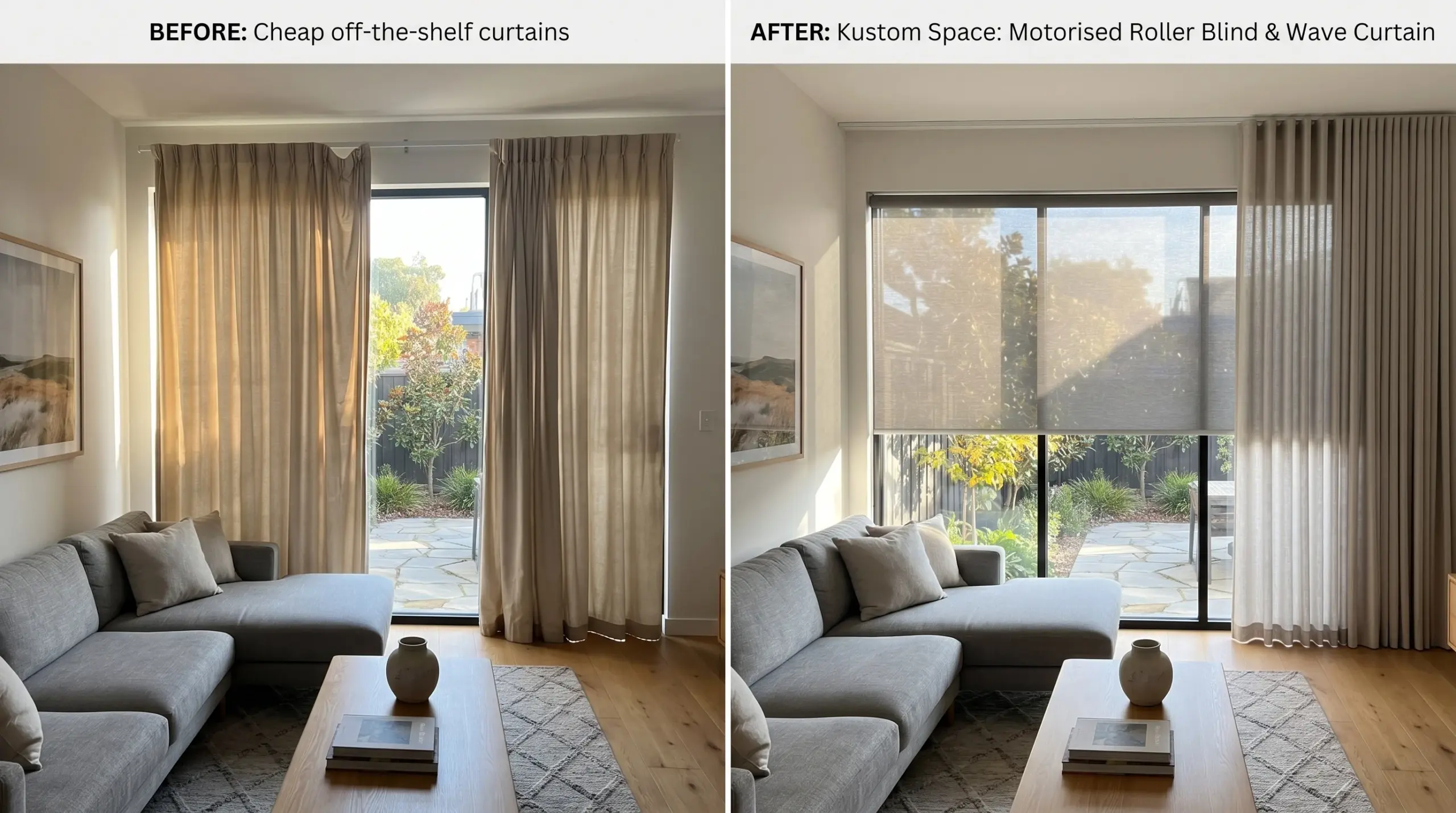
Neither blinds nor curtains are universally better. But the choice becomes clearer once you frame it around the specific function you need each window to perform.
Roller blinds in solar-control or blackout fabrics are the most efficient solution for west and south-facing windows where the primary goal is heat and glare management. They sit closer to the glass, are easier to clean (critical in dusty UAE environments), and in a motorised configuration can be programmed to lower automatically during peak afternoon hours. Motorised roller blinds in a quality system (Somfy or equivalent) typically run AED 600-1,200 per window including installation, depending on window size and fabric.
Curtains offer superior acoustic absorption, create a warmer and more layered aesthetic in formal living and dining rooms, and are better suited to full-height openings where a blind would require an unusually large roller tube. In many well-designed UAE villa projects, the answer is both: a solar roller blind on the window recess for climate control, paired with a wave curtain on a ceiling track for aesthetics and blackout when needed.
Venetian and wooden blinds are used in UAE villas but warrant a caution. Real wood slats can warp in rooms with fluctuating humidity, particularly bathrooms and kitchens near steam, and in direct sun. Faux-wood alternatives in PVC or composite aluminium perform better and are virtually indistinguishable visually at normal room distances.
How Long Do Custom Curtains Last in Dubai’s Climate?
Well-specified curtains and blinds in a UAE villa should last 8-12 years before fabric degradation becomes visible. But this assumes correct specification from the outset. The most common reason curtains fail early in Dubai is direct UV exposure without UV-stable fabric. Even 6 months of direct afternoon sun on a cotton or low-grade polyester will cause measurable colour shift and weakening of the weave.
The hardware typically outlasts the fabric if quality components are used. Anodised aluminium tracks and powder-coated steel brackets require no maintenance under normal UAE conditions. Occasional dust wiping and an annual check of gliders and end stops is sufficient. Motorised systems should have their batteries or transformer units checked annually. The electrical components are the most common failure point.
For UAE villas near the coast (JBR, Palm, Dubai Harbour), salt air adds a corrosion risk to metal components that is not present inland. Specify marine-grade or powder-coated fixings in these locations. Standard zinc-plated hardware will show rust at fixings within three to four years.
Motorised Curtains and Blinds: Are They Worth It in a UAE Villa?
In a UAE villa, motorisation shifts from a luxury to a practical tool fairly quickly once you consider the window sizes and summer conditions involved. Manually operating a 4-metre ceiling-height curtain multiple times a day is a friction point that most homeowners quietly resolve by simply leaving the curtains drawn permanently, which defeats the purpose.
Motorised systems allow you to schedule blinds to lower during the 1-5 PM peak heat window and raise as the sun moves off the facade. This single behaviour, run consistently, can reduce air-conditioning load on exposed rooms meaningfully. Somfy, Dooya, and Becker are the most commonly specified systems in UAE villa projects. All three have local service and parts availability, which matters when a motor fails.
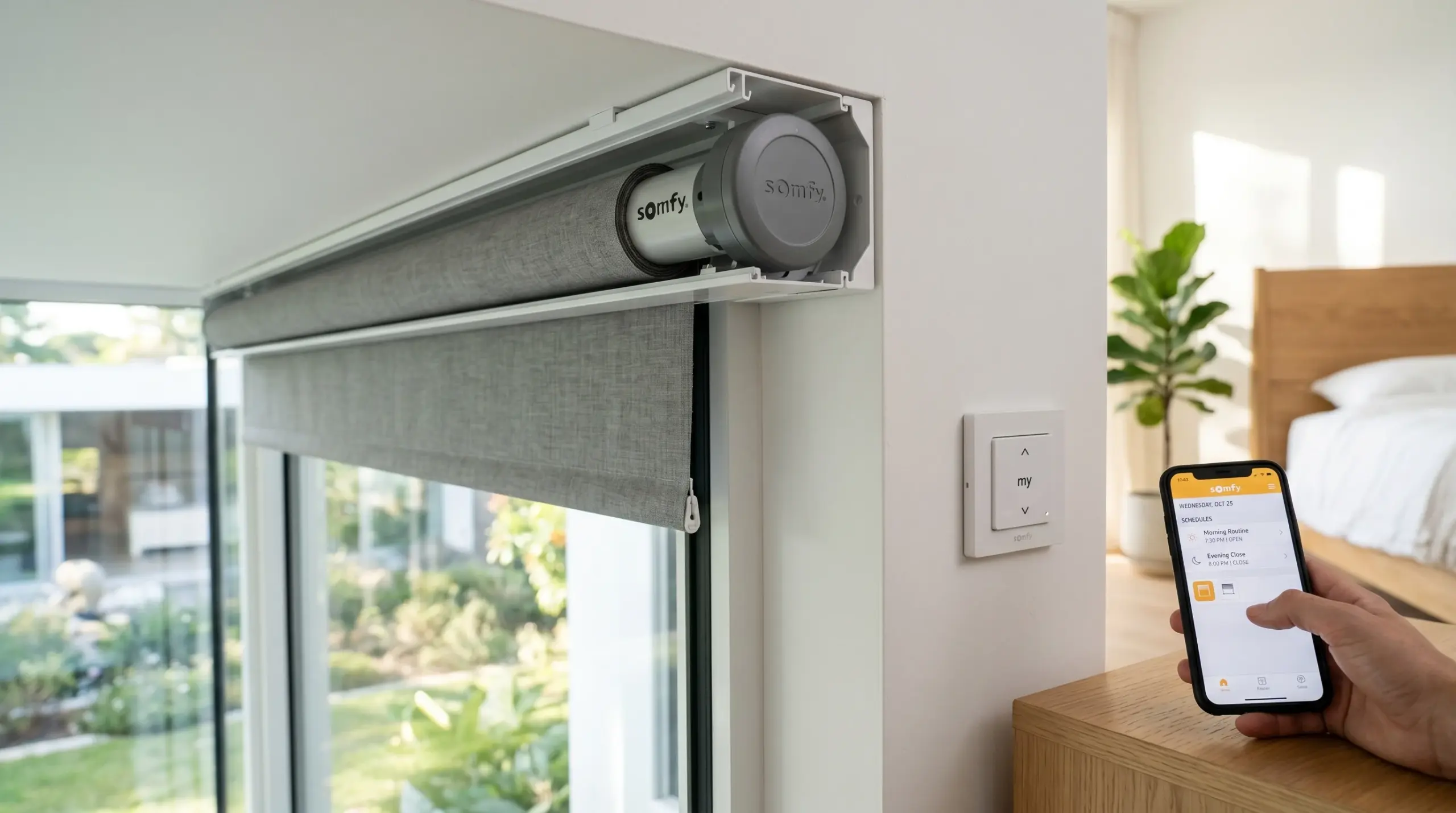
Budget realistically: motorisation adds AED 300-600 per blind or curtain track over a manual equivalent, including the motor unit and integration with a wall switch or smart home system. For full villa smart-home integration with KNX or Control4, allow for a programming cost on top of the hardware. The investment is recouped partly through energy savings and partly through the very real reduction in fabric wear. A curtain that spends less time absorbing direct solar radiation lasts longer.
What Should I Look for When Getting Curtains Fixed in a UAE Villa?
Choosing the right fabric is only half the project. The quality of installation determines whether your curtains perform as specified or underperform for years without a clear reason why.
Key points to assess before committing to a supplier:
- Ceiling-height tracks vs wall-mounted: Ceiling-mounted tracks with a 5-10 cm return to the wall eliminate side light bleed and create a cleaner, taller visual line. Wall-mounted tracks above the window frame are faster to install but visually interrupt the wall if the ceiling height is over 2.8 metres.
- Track quality: Specify a track rated for the fabric weight. Lightweight aluminium tracks sold at low price points are not designed for heavy lining combinations and will bow within 12 months.
- Measurement accuracy: In a villa with non-standard ceiling heights and irregular bay or corner windows, accurate measurement is the difference between curtains that hang flush and curtains with visible gaps. Insist on a site measure before any fabric is cut.
- Installation finish: Check that fixings into concrete (standard in UAE villa construction) use appropriate rawl plugs and that the installer patches and paints any surface damage on completion.
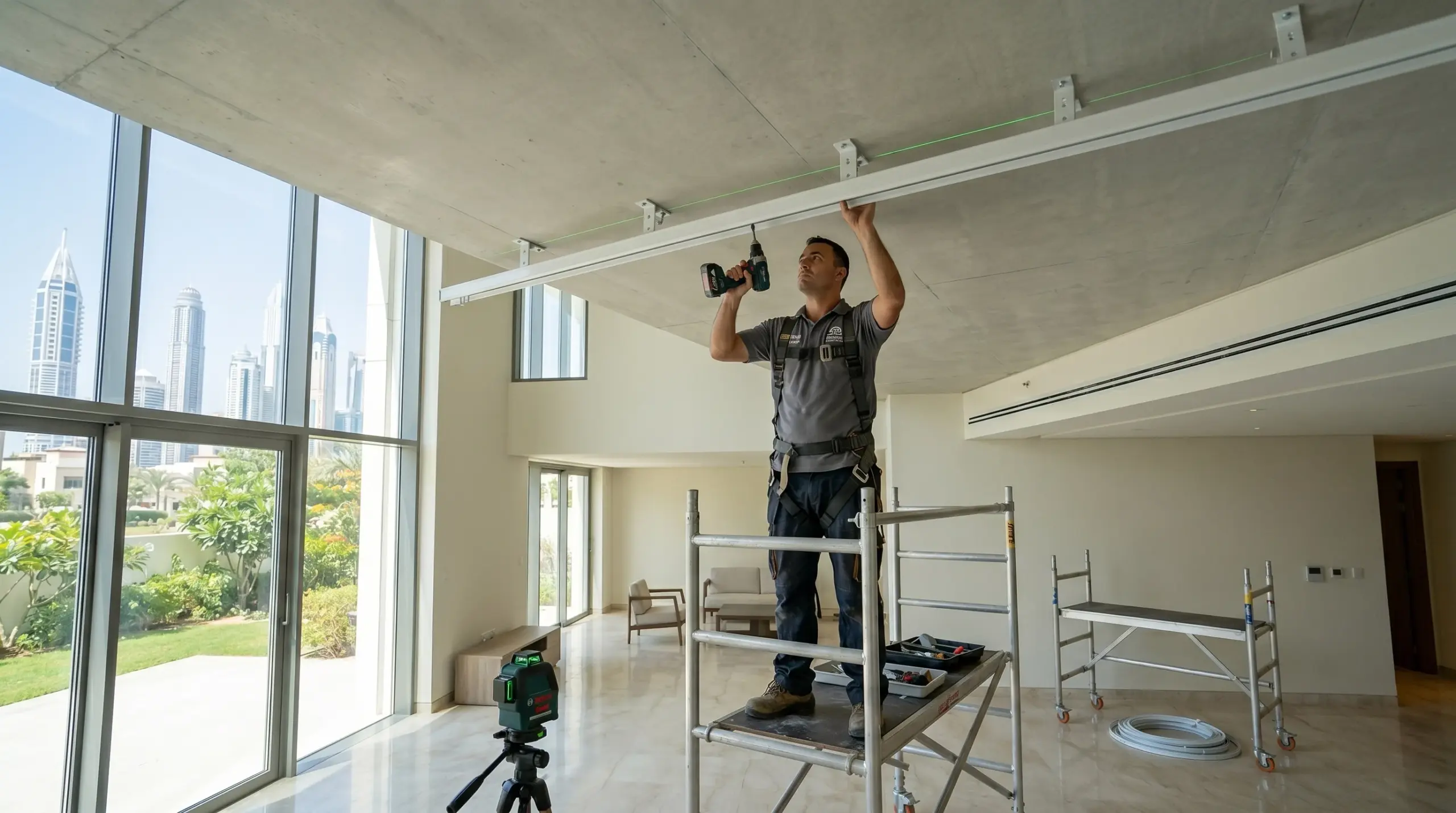
For professional curtain fixing in Dubai that covers measurement, supply, and installation as a managed process, our curtain fixing service at kustomspace.ae/curtain-fixing-dubai handles all three stages under a single project manager.
Choosing the Right Option for Your Villa
The decision framework for curtains and blinds in a UAE villa comes down to three variables: the orientation of each window, the primary function you need that window to perform (heat control, privacy, blackout, or aesthetics), and the installation quality you can realistically secure. Get those three right, and the fabric and system choices follow logically. Homeowners completing a full villa refresh often pair window treatment upgrades with flooring changes. Engineered wood specified for UAE humidity and temperature cycling, available at kustomspace.ae/engineered-wood-dubai, can be scheduled alongside curtain installation to complete before a single move-in.
Replacing window treatments is a significant project. The logistics of measuring, ordering, and installing across a full villa are not trivial, and the consequences of a poor specification are measured in years, not months. Kustom Space has been fitting out UAE villas for over a decade, working factory-direct on fabrics and hardware to give clients honest value at the mid-to-premium end of the market.
Call us today at +97145704540 or Email us at [email protected]