
Luxury Home Makeover Before & After – Dubai Real Projects
Most Dubai homeowners underestimate how much a tired interior is costing them, whether in rental yield, resale positioning, or simply the daily experience of being in a space that no longer feels right. A luxury home makeover in Dubai is not just about aesthetics. It is a considered investment in one of the most competitive property markets in the world, and the before-and-after difference, when done with the right team, is rarely subtle. What follows are real project accounts, honest cost figures, and the design logic behind decisions that transformed ordinary interiors into spaces that actually perform.
What Does a Luxury Home Makeover Actually Involve in Dubai?
A luxury home makeover in Dubai typically covers three to six rooms over a four to eight week period, depending on the scope and whether any structural changes are required. It is not a single-trade job. The transformation that reads as cohesive in a finished photograph is the result of coordinated decisions across flooring, window treatments, furniture, lighting, and wall finishes, all of which need to work within the specific proportions and orientation of a UAE villa or apartment.
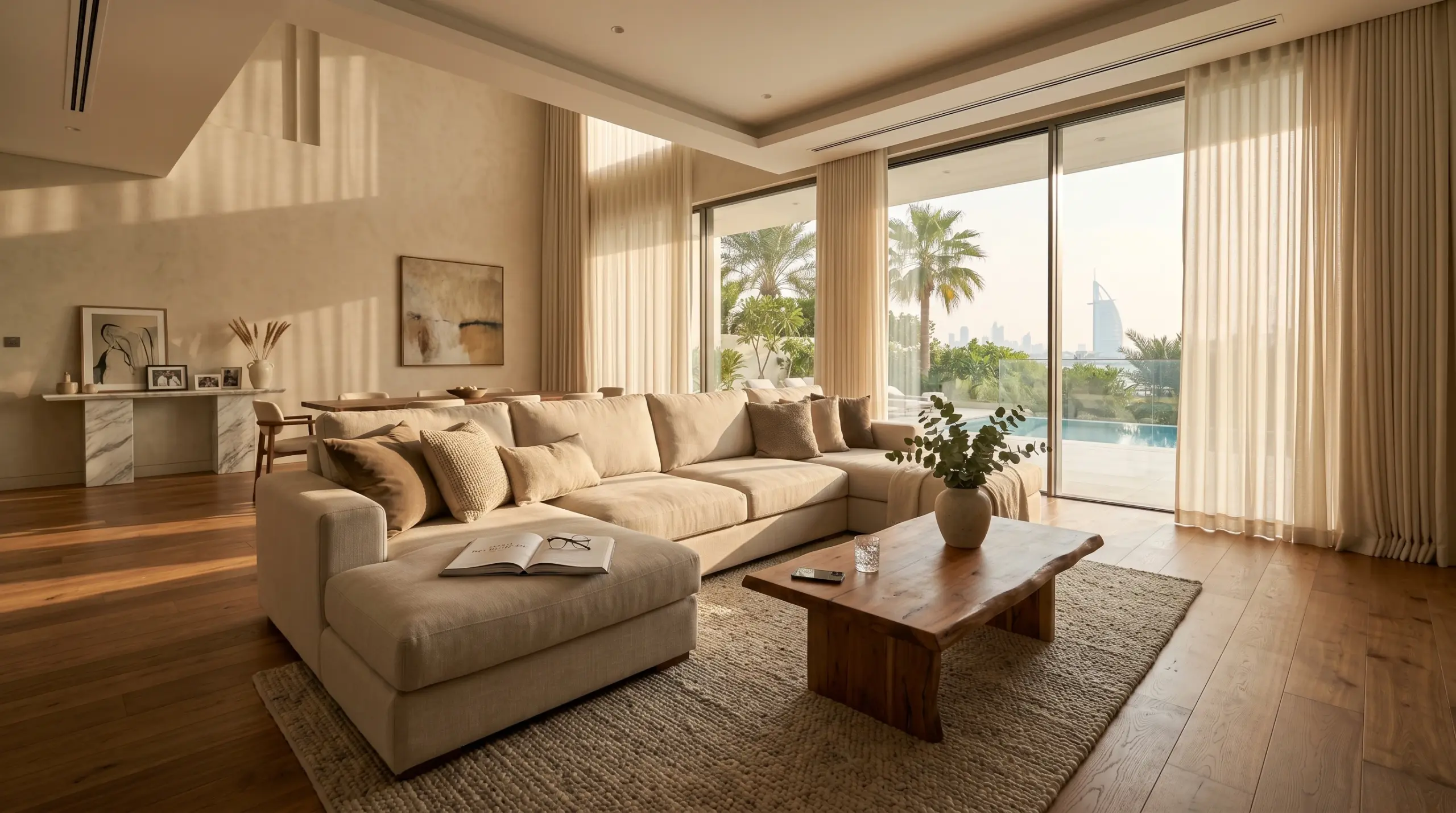
What separates a genuine luxury renovation from a cosmetic refresh is the quality of decisions made before any contractor lifts a tool. The projects we have worked on across Jumeirah, Emirates Hills, and the Palm consistently start the same way, with a detailed space assessment that accounts for natural light direction, the impact of the Dubai summer on west-facing rooms, and the way the family actually uses the space. A living room in a Palm Jumeirah villa that faces the water gets different flooring and window treatment recommendations than an identical footprint in a north-facing apartment in Business Bay. Material decisions in Dubai are never purely aesthetic.
The scope of a luxury makeover also depends on who owns the property and why they are renovating. Owner-occupiers in Jumeirah or Arabian Ranches typically priorities comfort, livability, and the quality of everyday experience. Investors renovating short-term rental units in Downtown Dubai or JBR weight decisions differently, focusing on photography performance, durability under higher tenant turnover, and finishes that read as premium without requiring specialist maintenance. Both are valid priorities, but they produce different material and design briefs, which is why the conversation before the first measurement matters as much as the installation itself.
Project One — Arabian Ranches Villa Living and Dining Transformation
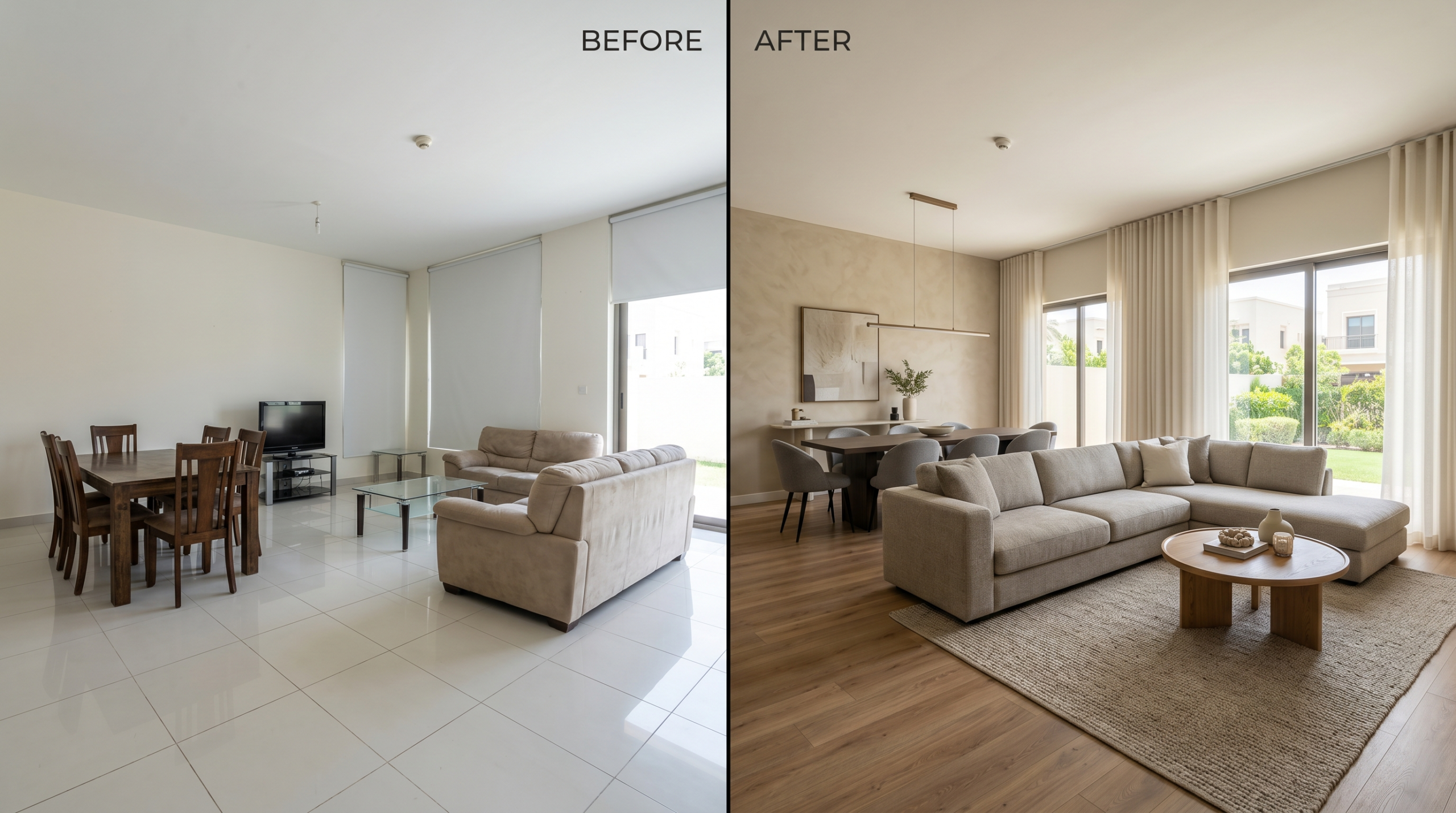
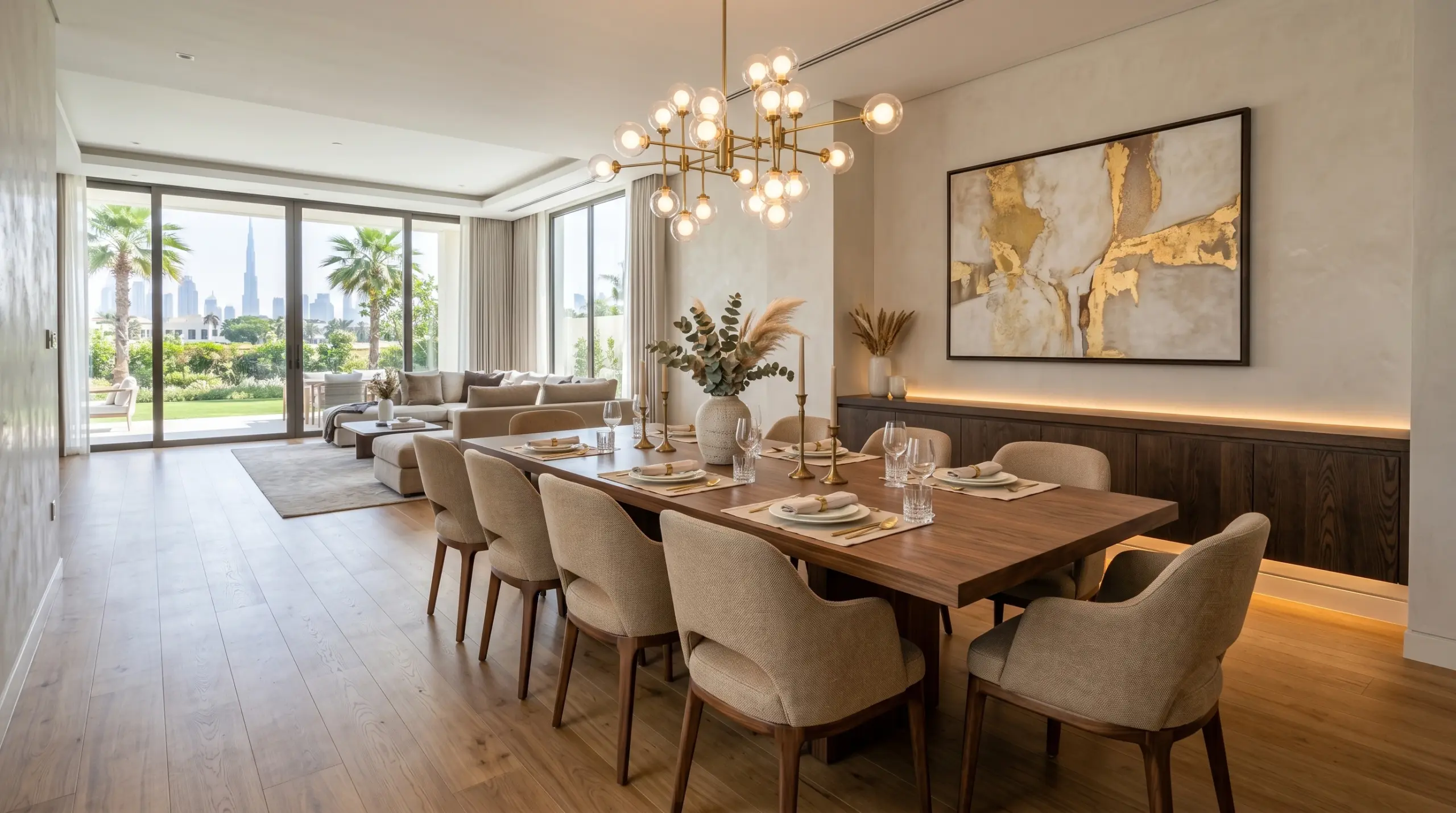
This project began as a flooring replacement and became a full ground-floor renovation once the homeowner saw what a change in surface material did to the perceived size and warmth of the space. The original villa had large-format white ceramic tiles throughout the ground floor, a common spec in mid-2000s Arabian Ranches properties, which were cold underfoot, echoed sound, and made the dining area feel disconnected from the rest of the home.
The family had lived in the villa for six years and had grown accustomed to the limitations of the original fit-out. The renovation conversation started with a simple question about whether the tiles could be replaced without disrupting the kitchen. It ended with a complete redesign of everything visible from the front door.
What Changed and Why?
The ceramic tiles were replaced with a wide-plank engineered wood in a warm oak finish across the living and dining areas, with a transition to a custom loop-pile carpet in the family room. Engineered wood in Dubai requires careful specification. The core must be dimensionally stable enough to handle the shift between air-conditioned interiors and the ambient humidity that comes through during the brief spring months when residents open windows. The boards installed in this project had a multi-layer core with a UV-lacquered surface rated for the UAE climate, and they were installed with a 10mm expansion gap along all perimeter walls to account for the temperature differential between summer and winter. Cost for the flooring component ran to approximately AED 38,000 installed across 210 square meters, including underlay and threshold strips.
If you are comparing flooring options for a similar project, our guide to engineered wood flooring for UAE conditions covers the specification differences that matter most in Dubai’s climate.
The window treatment in the living room
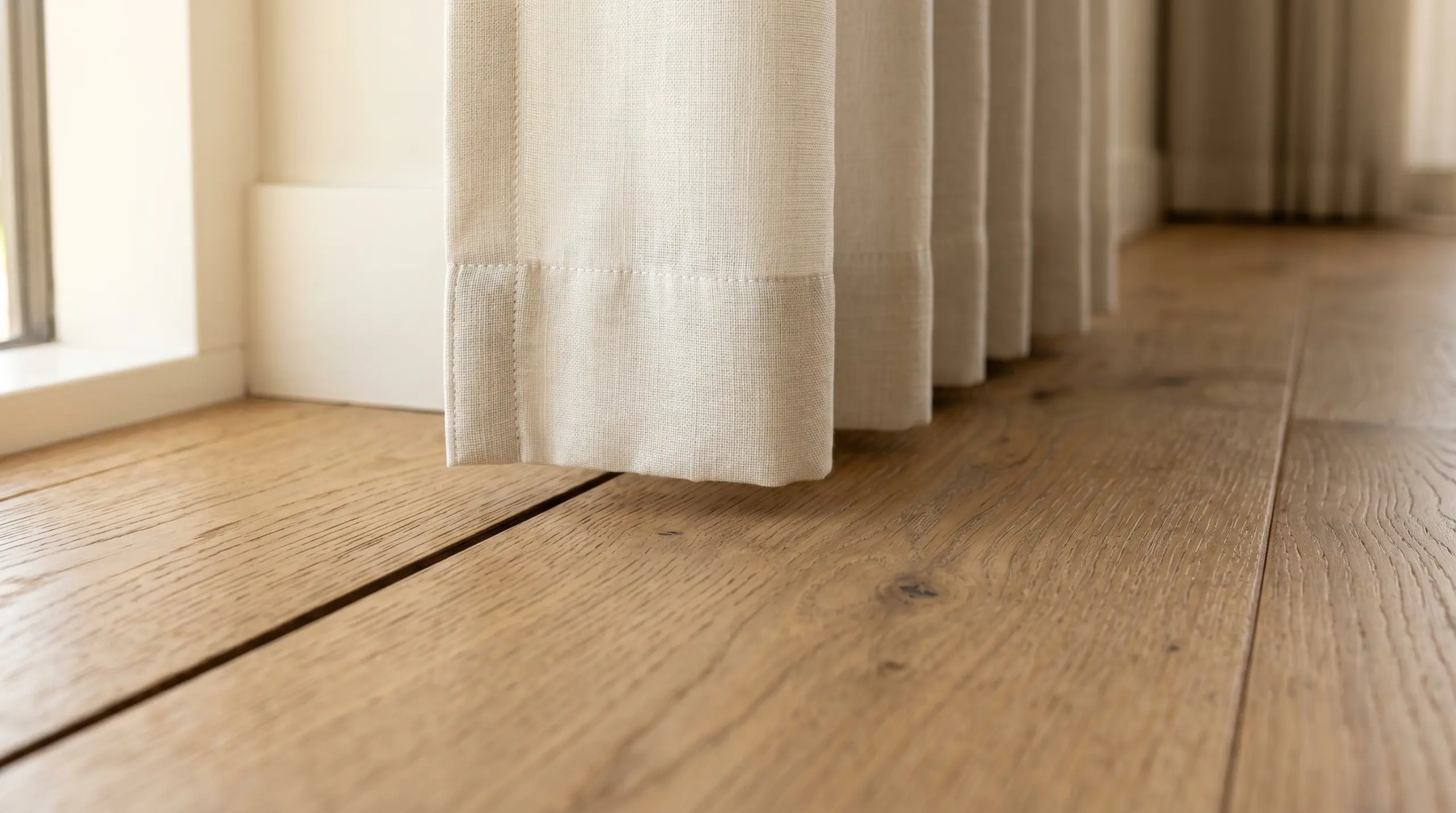
Moved from cheap roller blinds to floor-to-ceiling wave-fold curtains in a warm ivory linen-look fabric, tracked on a recessed ceiling mount. This single change, covering a three-panel sliding door configuration from floor to ceiling rather than window to sill, altered the entire sense of ceiling height in the room. The curtains did not just change the look. They reduced heat gain through the glazing by a meaningful margin, which matters in a west-facing Arabian Ranches living room where afternoon sun in July and August would otherwise push the air conditioning into continuous operation. Installed cost for the living and dining curtains was AED 14,500. For full specifications on track systems and fabric options for this curtain style, see our dedicated page on wave-fold and S-fold curtains in Dubai.
The dining area received a custom built-in
Sideboard in a warm walnut veneer with integrated lighting underneath, which anchored the space and gave it a purposeful focal point. The original dining room had no storage and no fixed furniture beyond the table and chairs, which made it feel like a through-route rather than a destination room. The sideboard cost AED 9,500 and was fabricated locally with a four-week lead time from design approval.
Feature wall treatment in the living room
Used a textured wallpaper in a warm sand tone behind the main sofa wall. The paper was a non-woven type with a foam-relief texture, chosen specifically because it is dimensionally stable in the humidity range typical of Dubai interiors and does not peel at the seams during the summer months when air conditioning cycling causes daily contraction and expansion of wall surfaces. Material and installation cost for the feature wall: AED 4,200.
The furniture was replaced in stages
Rather than all at once, which is a practical approach many Dubai families take when coordinating a renovation around school holidays and summer travel. The custom sofa and dining set were ordered at the start of the project and arrived during week four of the five-week renovation window, meaning the family returned from their summer break to a completed space.
The Before and After in Numbers
The homeowner originally planned for a flooring-only project with an AED 30,000 budget. However, after the design consultation, the final scope expanded to cover flooring, curtains, a feature wall, a built-in sideboard, and furniture, bringing the total spend to AED 118,000. The team completed the project in five weeks from design sign-off to handover. Because the timeline ran through July and August, peak summer workshop capacity added one week to the curtain fabrication. At handover, the homeowner remarked that the space felt like an entirely different house, rather than simply a renovated version of the old one.
Project Two — Downtown Dubai Apartment Bedroom Suite Overhaul
A two-bedroom apartment in a Downtown Dubai tower, owned by an investor who used the property personally during visits and rented it out the rest of the year, needed a refresh that would serve both purposes. It had to be comfortable enough for personal use and premium enough to command higher short-term rental rates on the platforms the owner used.
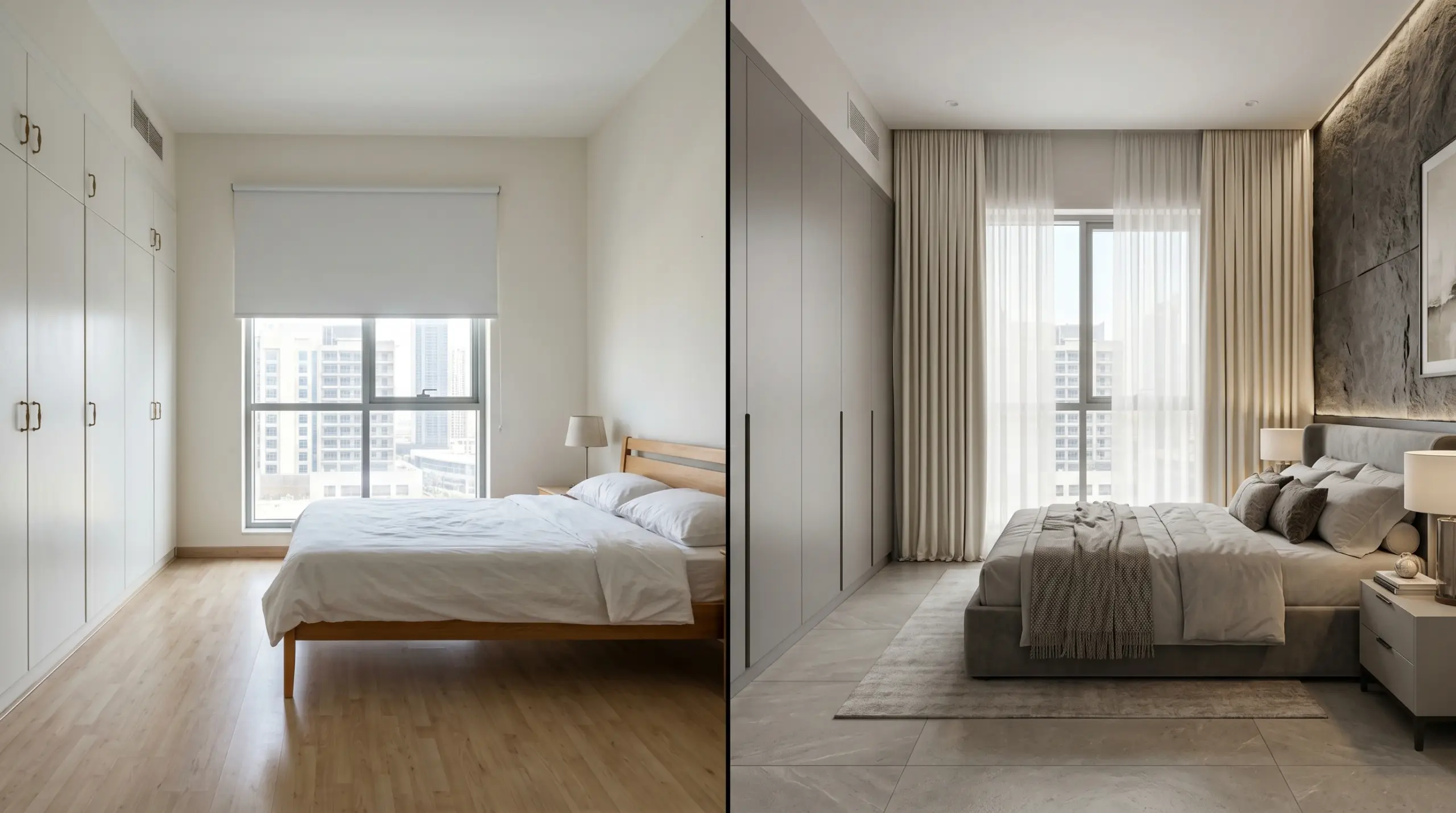
The master bedroom started with a dated built-in wardrobe in a medium-toned MDF with brass-effect handles, the kind of factory-fitted finish that was standard across a significant proportion of Downtown handovers between 2012 and 2018. The room had good proportions and a city view, but the wardrobe dominated one full wall in a way that reduced rather than celebrated the space. The flooring was a pale laminate in reasonable condition but visually inert. The window had a single blackout roller blind that provided function without contributing anything to the atmosphere of the room.
Design Decisions That Changed the Room
The built-in wardrobes were replaced with floor-to-ceiling custom wardrobes in a matte stone finish with recessed aluminum handles and integrated LED strip lighting on the interior. The clean face of the new wardrobes, without visible handles or frame lines, made the wall read as a continuous surface rather than a furniture piece. This is a small distinction in description but a large one in experience. Custom wardrobe fabrication and installation in Dubai for a full wall of this scale typically runs AED 18,000 to AED 32,000 depending on the internal configuration and finish quality. This project came in at AED 24,500 for the wardrobes, including a pull-out vanity unit and divided accessory drawers. Readers planning a similar scope can explore finish options and configurations through our custom wardrobes in Dubai page.
The window treatment
Moved from a single blackout roller blind to a double-track system with a sheer layer and a full blackout layer in a soft greige fabric. The dual-track approach gives the room visual softness during the day when only the sheer is drawn and full privacy and light control at night. For short-term rental photography, the layered look of the curtains against the city view behind the sheer consistently performs well on listing platforms. Installed cost for the master bedroom curtains was AED 6,800.
The laminate flooring was replaced
With a large-format porcelain tile in a warm greige tone, chosen to align with the wardrobe finish and create a coherent palette across the room without the maintenance concerns that wood flooring can present in a high-turnover rental property. Porcelain in this specification, at 80x80cm format with a rectified edge, ran to AED 8,200 installed including adhesive and grout in a matching tone.
The team completed the room with a new upholstered bed frame in a charcoal bouclé fabric, two bedside units in a natural oak finish, and a textured wallpaper feature wall behind the headboard, using a tone that sat between the greige floor and the stone wardrobe finish. In total, the bedroom renovation cost AED 52,000. Upon relisting the property on a premium short-stay platform, the owner achieved a rental rate increase of approximately AED 300 per night during the first month, fully recovering the renovation cost within a single high-season quarter.
Transforming the Second Bedroom
The second bedroom received a more targeted treatment to respect the overall budget allocation. The team retained the wardrobe but repainted it and fitted new handle hardware for AED 1,800. A new roller blind with a light-filtering fabric replaced the original blackout, flooding a previously dark, closed room with natural daylight. The design team then added a new bed frame and mattress, alongside a single feature wall that used a painted panel effect in a contrasting tone. Spending AED 14,500 on this second bedroom lifted the entire space from purely functional to genuinely presentable in rental photography.
Project Three — Sharjah Family Villa Full Ground Floor
We specifically include this project to illustrate how a luxury home makeover in Dubai and the wider UAE does not require a Palm Jumeirah address or a nine-figure renovation budget. The brief came from a family who had been in their Sharjah villa for eleven years and wanted the ground floor to feel new without relocating.
The original ground floor had wall-to-wall beige carpet throughout the majlis and formal dining room, which had accumulated the kind of wear and discoloration that no cleaning regime resolves. The family sitting room had a polished marble tile that looked expensive in isolation but was visually disconnected from the rest of the floor plan. There were no curtains in the formal dining room, and the majlis had floor-to-ceiling sheers in a yellowed white that had been there since the original fit-out.
Flooring Across a Mixed-Use Ground Floor
The team removed the carpet and replaced it with a large-format porcelain tile in a warm ivory with a soft texture finish. They selected this specific tile to echo the marble without matching it exactly, which would have looked contrived. Rather than changing materials between rooms, a single threshold strip in brushed brass handled the transition, unifying the floor visually while allowing each room to retain its distinct character. In total, installing 280 square meters of flooring across the majlis, dining room, and entrance hall cost AED 52,000.
The team retained and professionally polished the family sitting room marble, restoring it to a condition that looked intentional alongside the new porcelain rather than a design oversight. For a standard restoration in UAE villas, specialists typically charge AED 25 to AED 45 per square meter to grind, polish, and seal marble, depending on the surface’s current condition.
Window Treatments for a Traditional Majlis
The majlis required particular care in window treatment selection. The room faces east and receives strong morning sun through three large windows, which created a glare problem during the family’s main gathering hours in winter. The solution was a layered system: a solar roller blind on each window to manage glare and UV without blocking the view, combined with floor-to-ceiling curtains in a rich jewel-toned fabric that framed the windows when open and gave the room warmth and formality when drawn in the evening.
This combination, solar blind plus drape, is one we use frequently in UAE majlis spaces because it solves the light management problem during the day without sacrificing the visual weight that a formal reception room needs after sundown. Installed cost for the three majlis windows: AED 18,400 including both the roller blind mechanism and the curtain track with fabric. The dining room received a simpler treatment: a wave-fold curtain in a warm ivory that matched the new tile tone, installed on a ceiling-mounted track that drew the eye upward in a room with high ceilings.
Total project spend across the Sharjah ground floor: AED 142,000 covering flooring, marble restoration, window treatments for majlis and dining, entrance feature wall, and new lighting fixtures throughout.
How Long Does a Luxury Home Makeover Take in Dubai?
A full luxury home makeover in Dubai, covering four to six rooms with custom flooring, window treatments, furniture, and wall finishes, typically takes six to ten weeks from design sign-off to handover. The breakdown matters: design and material selection takes one to two weeks, fabrication of custom elements runs two to four weeks, and installation of all trades in sequence adds another two to three weeks.
The variables that stretch timelines in Dubai are predictable and worth planning around. Ramadan affects workshop output and contractor availability, particularly in the final ten days when the pace of work slows significantly across all trades. Eid Al Adha creates a hard pause of five to seven days, halting deliveries and installations regardless of how well you manage the project up to that point. Summer months from June through August are paradoxically efficient for indoor renovation work. Contractors are available, the family is often abroad, and air-conditioned villa interiors are comfortable to work in. Custom fabric orders placed with international suppliers during this period may carry longer lead times due to reduced manufacturing schedules in Europe, so local fabric sourcing during summer is worth considering.
The most reliable timeline strategy for a luxury home makeover in Dubai is to begin the design process in April or May, place all custom orders before Eid Al Adha, and target a completion date in late September or October when the family is back and the cooler season is beginning. Projects that start this sequence in January or February and aim for completion before Ramadan are also manageable, but the Ramadan buffer needs to be built in explicitly rather than hoped around.
What Causes Renovation Delays in Dubai?
The most common causes of delay on luxury home makeovers in Dubai are not contractor incompetence. They are sequencing failures. Installing flooring before measuring built-in furniture forces the carpenter to work around a finished floor, creating practical difficulties and risking damage. Measuring curtains before positioning the furniture means you may have to recalculate the drop length if the sofa sits differently than planned. Finally, installing wallpaper before repositioning electrical sockets guarantees you will have to redo one of those finishes.
The sequence for a well-managed renovation is: structural and electrical work first, then flooring, then built-ins and fitted furniture, then loose furniture delivery, then curtains and blinds last. Curtains last is a rule that experienced fit-out teams follow without exception. It protects the fabric from dust and damage during the earlier trades and allows the curtain measurement to be done against the finished room rather than a half-complete space.
What Does a Luxury Home Makeover Cost in Dubai?
Cost depends on scope, finish quality, and whether any structural work is involved. Based on real project data, a luxury home makeover in Dubai covering a full villa ground floor or a three-to-four room apartment typically runs between AED 180,000 and AED 450,000 for a genuinely premium finish. Cosmetic-only transformations covering surfaces and soft furnishings without structural changes sit in the AED 80,000 to AED 180,000 range for a comparable footprint.
The cost breakdown on a typical four-bedroom villa renovation in Jumeirah or Mirdif looks approximately like this. Flooring across all ground-floor areas and the master bedroom in engineered wood or premium carpet typically runs AED 45,000 to AED 90,000 depending on material and area. Custom curtains and blinds for the full villa run AED 35,000 to AED 75,000 depending on fabric specification and the number of tracked openings. Custom furniture for the living room, dining room, and master bedroom runs AED 60,000 to AED 150,000. Wardrobes for three to four bedrooms typically cost AED 40,000 to AED 90,000. Wall finishes, wallpaper, and paint add AED 15,000 to AED 35,000.
These are honest ranges, not aspirational figures. The difference between an AED 200,000 and an AED 380,000 outcome for the same footprint is almost entirely in material selection and the number of rooms brought to full specification versus partial refresh. A homeowner who budgets AED 200,000 and applies it strategically to flooring, curtains, and the master bedroom will achieve a more credible result than one who spreads AED 200,000 thinly across every room.
Where Do Homeowners Waste Their Budgets?
Homeowners most commonly waste money on Dubai luxury home makeovers by allocating funds to decorative accessories before resolving the foundational elements. Because artwork, vases, cushions, and decorative lighting provide immediate visual feedback, buyers purchase them easily for a sense of psychological satisfaction.
However, a room with exceptional flooring and curtains and simple accessories will always outperform a room with poor flooring and an expensive accessories collection. Designers and homeowners should spend that money on the surfaces first.
The second inefficiency is underspecifying on curtain tracks and over specifying on curtain fabric. A premium fabric on a cheap track system produces a curtain that does not hang correctly, does not draw smoothly, and looks wrong in a way that is difficult to diagnose without experience. The track system is the structure on which everything else depends. Spending AED 800 per meter on fabric and AED 40 per meter on the track is a false economy that experienced design teams avoid.
What Should You Priorities in a Dubai Home Makeover?
The single highest-impact change in almost every luxury home makeover in Dubai is the floor. Flooring covers more surface area than any other single element, appears in every room, affects acoustics and temperature perception underfoot, and serves as the background against which every other decision reads. Getting the floor wrong makes everything else harder to resolve, and the only way to fix it later is to redo it. There is no remedial surface treatment that turns the wrong floor into the right one.
Window treatments rank second. Dubai villas and apartments deal with intense UV exposure that degrades cheap fabrics within two to three years. They experience significant heat gain through west and south-facing glazing during eight months of the year, and they present privacy considerations that differ fundamentally between villa compounds, gated communities, and tower apartments. A well-specified curtain or blind system addresses all three factors simultaneously while contributing substantially to the visual finish of the room, particularly in living areas where the window is the largest single surface the eye encounters.
Furniture and built-in storage matter enormously but are more forgiving to phase across a longer timeline. A room with exceptional flooring and curtains and simple furniture reads as a curated space in progress. The same room with poor flooring and a premium furniture collection reads as confused, because the eye goes to the floor whether the designer intended that or not. If you are beginning to think about furniture selection alongside your renovation, our living room furniture for Dubai homes range complements a full fit-out rather than working as standalone pieces..
The sequence of decisions matters as much as the decisions themselves. Floor first, windows second, built-ins third, loose furniture and lighting fourth, accessories last.
Which Rooms Deliver the Best Return on Renovation Investment?
In Dubai, the living and dining room combined consistently delivers the highest return on renovation spend, whether the goal is personal enjoyment, rental yield, or resale positioning. It is the first space a visitor, tenant, or potential buyer encounters, and it sets the quality expectation for everything beyond it. A buyer who walks into a Palm Jumeirah villa with an exceptional ground floor will extend the benefit of the doubt to unrenovated bedrooms—something they would never do if the entrance and living room looked tired.
Renovating the master bedroom particularly the wardrobe, window treatments, and bed configuration delivers strong results for short-term rental positioning. This specific room appears most frequently in professional listing photography, and short-stay guests often use it as the deciding factor when choosing between comparable properties.
Kitchen renovations carry a high cost relative to visual impact, unless the original finish genuinely dates or functionally limits the space. Homeowners should leave a working, broadly modern kitchen alone and instead apply that budget to living areas and bedrooms. The only exception involves an open-plan kitchen in a villa or large apartment; because guests can see the kitchen from the main living space, a mismatched finish will undermine the visual coherence of the entire floor.
How Do You Find a Reliable Luxury Home Renovation Company in Dubai?
The Dubai renovation market has a wide spread of quality at every price point. At the premium end are companies that manage the full scope in-house, covering design, fabrication, and installation without subcontracting trades to third parties who have no ownership of the final outcome. The clearest indicator of a reliable renovation partner is whether they can show you real completed projects in Dubai, not international portfolio images, not three-dimensional renders, but actual finished rooms in actual UAE properties that you can assess in photographs taken in real conditions.
Ask specifically about projects in property types and areas similar to yours. A company that has renovated several villas in Jumeirah understands the ceiling heights, the natural light conditions, the community access restrictions for delivery vehicles, and the contractor dynamics in that area in a way that a company working primarily on Business Bay apartments does not.
Questions to Ask Before Signing Any Renovation Contract in Dubai
Before committing to a renovation partner for a luxury home makeover in Dubai, three conversations will tell you most of what you need to know.
The first is about sequencing. Ask them to walk you through the installation order for a project of your scope. If they cannot give you a clear sequence with reasons, that is informative.
The second is about material substitution. Ask what happens if a specified material is unavailable during the project. A reliable contractor has a documented substitution process that requires client approval. An unreliable one has a habit of making those decisions without telling you.
The third is about post-completion support. Ask what happens if something fails within the first three months after handover, whether a curtain track jams, a flooring board lifts at a joint, or a built-in door does not close correctly. The answer tells you whether the company sees handover as the end of their responsibility or the beginning of a relationship.
Contact Us
A luxury home makeover in Dubai is most successful when the design process drives the budget rather than the other way around. Understanding what the space needs first, then allocating resources to the elements that deliver the most impact for your specific property and lifestyle, produces results that hold up over time in a way that budget-first approaches rarely do. This kind of renovation is not a decision to rush, and a good design partner will not suggest otherwise.
Kustom Space has been managing full home transformations across Dubai, Abu Dhabi, and Sharjah for over a decade, handling projects from initial design through to installation and handover without subcontracting the elements that determine whether the result is genuinely premium or merely adequate. If you would like to talk through what a makeover could look like for your specific property before committing to anything, our team is on WhatsApp with no sales pitch and no pressure, just straight answers from people who have done this work many times in this market.
Call us today at +97145704540 or Email us at [email protected]
Related Articles
Complete Home Renovation Guide Dubai: Costs, Timeline and Process